
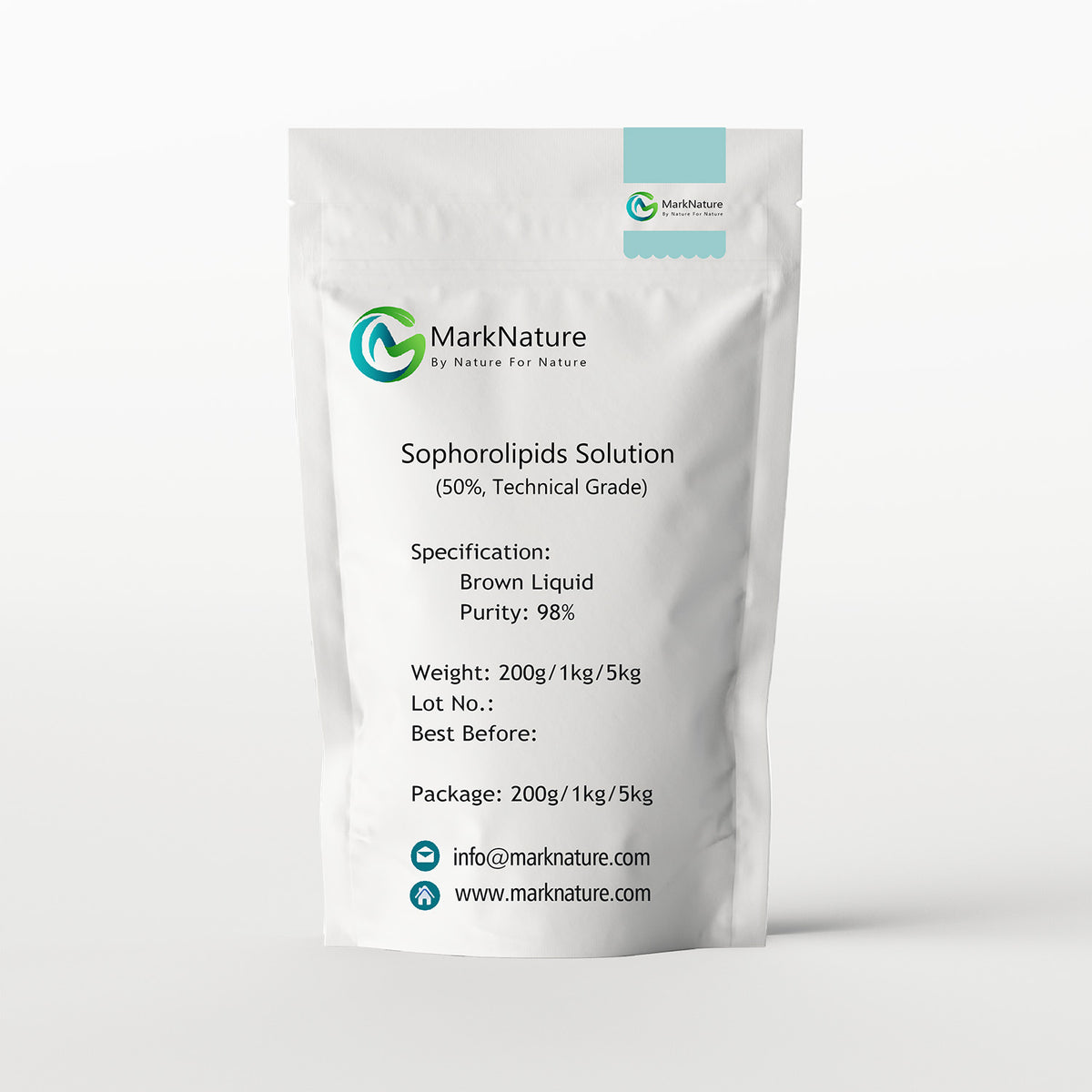

Description
Sophorolipids are fermentation-derived glycolipid biosurfactants produced using sugar and vegetable oil as carbon sources, followed by downstream physical extraction and purification.
This product is supplied as a light yellow to brown liquid containing approximately 45–55% sophorolipids, with a nominal concentration of 50%. The sophorolipid fraction has a dry-basis purity of not less than 98.0%.
The product contains both acidic and lactonic sophorolipid derivatives, with an approximate lactonic sophorolipids : acidic sophorolipids ratio of 1 : 2.5–3.0.
Sophorolipids exhibit useful biosurfactant properties including surface-tension reduction, emulsification, wetting, dispersion, solubilization and low-foaming behavior. They can be considered as bio-based surfactant ingredients for home care, personal care, agriculture, petroleum, environmental and other industrial formulation systems.
Specification:
Product Type: Glycolipid Biosurfactant
Sophorolipids Type: Acidic and Lactone Acetylated Compounds
Lactonic / Acidic Sophorolipids: Approx. 1 : 2.5–3.0
Appearance: Light yellow to brown liquid
Nominal Sophorolipids: 50%
Purity (Dry Basis): ≥98.0%
pH (10% solution): 3.5-7.5
Solubility: Readily soluble
Key Features:
- Fermentation-Derived Biosurfactant: Produced using sugar and vegetable oil as fermentation carbon sources.
- High-Purity Active Fraction: Sophorolipid fraction with dry-basis purity of at least 98.0%.
- Balanced Sophorolipid Composition: Contains both acidic and lactonic sophorolipids.
- Low-Foaming Characteristics: Suitable for formulations where excessive foam is undesirable.
- Surface-Active Performance: Supports wetting, emulsification, dispersion, solubilization and surface-tension reduction.
- Water Compatible: Readily soluble in water and can also be diluted with many alcohol- and ester-based systems.
- Bio-Based Alternative: Can be considered as a partial replacement for conventional synthetic surfactants in suitable formulations.
Applications and Benefits:
1) Home Care and Cleaning
Sophorolipids can be incorporated into household and institutional cleaning formulations where low-foaming surface activity is desirable.
Typical formulation functions may include:
-
Wetting
-
Dispersion
-
Emulsification
-
Degreasing support
-
Soil removal
-
Surface-tension reduction
-
Low-foam cleaning systems
Typical applications include household cleaners, surface cleaners, laundry-related formulations and specialty cleaning products.
2) Cosmetics and Personal Care
Sophorolipids may be considered for use as bio-based surfactant or functional ingredients in personal-care formulations.
Potential applications include:
-
Facial cleansers
-
Body wash formulations
-
Skin-care systems
-
Hair-care products
-
Mild cleansing formulations
-
Emulsified cosmetic systems
Their low-foaming, wetting, emulsifying and moisturizing-related characteristics can support formulation development depending on the final product system.
3) Petroleum and Oilfield Applications
Sophorolipids may be used in certain petroleum and oilfield formulations due to their ability to reduce surface and interfacial tension.
Potential applications include:
-
Oil displacement formulations
-
Oil/water emulsification systems
-
Enhanced dispersion systems
-
Specialty oilfield surfactant formulations
Performance should be validated under the specific salinity, temperature and process conditions of the intended application.
4) Agriculture
Sophorolipids may be incorporated into agricultural formulations as bio-based surface-active ingredients.
Potential uses include:
-
Agricultural wetting systems
-
Fertilizer formulations
-
Pesticide formulation support
-
Emulsification and dispersion systems
-
Soil-treatment formulations
Compatibility with active ingredients and final formulations should be evaluated before commercial use.
5) Environmental Applications
Due to their surfactant and solubilization properties, sophorolipids may be considered for use in certain environmental remediation and treatment systems.
Potential applications include:
-
Soil washing
-
Oil-contaminated surface treatment
-
Solubilization of hydrophobic organic materials
-
Water-treatment formulation development
-
Remediation-related dispersion systems
Actual performance depends on contaminant type, concentration, pH, salinity and process conditions.
6) Advanced Materials and Nanotechnology
Sophorolipids may also be explored as functional surface-active materials in advanced formulation and materials research.
Potential applications include:
-
Nanoparticle dispersion
-
Surface modification
-
Structure-directing systems
-
Catalyst-related formulations
-
Functional material research
These applications generally require specific formulation and performance validation.
Formulation and Handling Considerations:
Sophorolipids Liquid 50% may be diluted with water and with many commonly used alcohol- and ester-based solvents.
For best performance:
-
Avoid direct combination with strong acids or strong alkalis.
-
Particular caution is recommended at pH below 4 or above 10.
-
Recommended processing/use temperature: 15–90°C.
-
The product has been tested for structural and functional stability at temperatures up to approximately 150°C, depending on exposure conditions.
-
Flowability may decrease below approximately 15°C.
-
If phase separation occurs during storage, especially under large day/night temperature variations, mix thoroughly before use.
Preservation and Microbiological Considerations:
The product has certain antimicrobial-related functional characteristics; however, once the package is opened, it is recommended to use the product as soon as practical.
Unused material should be:
-
Resealed promptly
-
Stored in a cool, dry and ventilated area
-
Protected from contamination
-
Refrigerated if necessary, but not frozen
Opened, repacked or improperly stored material may have a shorter usable storage period.
If the finished formulation requires additional preservation or stricter microbiological control, suitable preservatives or validated sterilization methods may be considered after compatibility and preservation-challenge testing.
Storage:
Store in the original sealed container in a cool, dry and well-ventilated warehouse.
Protect from:
-
Direct sunlight
-
Excessive heat
-
Freezing
-
Contamination
-
Strong acids
-
Strong alkalis
Mix thoroughly before use if phase separation occurs.
Shelf Life:
24 months from the date of manufacture when stored under recommended conditions in the original sealed packaging.
Transportation
The product is generally transported as non-dangerous goods.
Protect from prolonged sunlight and excessive temperature during transportation.
Applicable transport requirements should be confirmed according to destination-country regulations and carrier requirements.